A recent New York Times headline laments the disappearing, “literary man.” For the curious, the article is entitled “Why the Disappearance of the Literary Man Should Worry Everyone”; and, yes, it is behind a paywall. This article has been commented on ad nauseam in a variety of outlets by a variety of commentators. I’ll try not to simply regurgitate what they’ve had to say. I do, however, want to give my opinion on this absolute train-wreck of a headline lacking any modicum of self-awareness. Here’s the thing…the literary man hasn’t disappeared. Nor is he disappearing. He has simply stopped buying the vomit-inducing garbage heap that is a massive chunk of modern literature which would be better served shredded and used to line the cages of laboratory animals—or, simply incinerated on the off chance that a lab chimp learns to read, leaving him to an existence more torturous than being used to test ebola vaccines.
I want to start by pointing out that my interest in what is available at most bookstores began to decline starting around 2011 or so. I will add that, around the same time, I was able to find at least some solace in used bookstores. Manassas, VA, had a particularly excellent one in McKay’s Used Books. (Second & Charles, a BigCorp competitor, was less impressive, despite having taken over the former Borders location in Woodbridge on the other side of the county.) I haven’t had such good experiences since leaving that area around 2016, but later visits impressed on me that nothing had changed much. The best bookstore in town was still a used bookstore.
This is not because I stopped reading, but is the result of multiple factors—most key being changes in the way I consumed literature. I had less time, because I was pursuing a degree in Electrical Engineering, so much of the literature I was consuming was of a more technical—and mathematical—nature. None of it was at the typical bookstore, though some of the textbooks were available online. I found that a lot of what I was interested in more immediately—books on heraldry, for example—were public domain and had been made available online for free through outlets like the Internet Archive and the Gutenberg Project. (This even includes some primary sources such as Martin Luther’s 95 Theses.) Mostly, though, the genres which I was interested in changed in ways which I was not interested in continuing to keep up with.
For science fiction and fantasy, the genres changed to books I largely wasn’t interested in. (Sorry, I’m not interested in grimdark, “gritty realism” which is neither gritty nor realistic, or a fat old champagne-socialist gooning on the page.) And, now, fantasy especially has hit the point where most of what is on shelves would be better placed under romance. What little is left is primarily older books which either I or my dad already own earlier editions for—especially when it comes to what I’m interested in. There have been exceptions, but they have been very few and very far between. Of course, there is a growing and relatively robust indie market which I plan to delve into as money becomes available, but that’s another topic for another time.
As for other topics like science and nature, they have made gradual slides from simply non-technical work to popular but often useless explanations and propaganda for dubious scientific theories. The history books on the shelves are increasingly either only cover 1934-present or are mired in the postmodern pseudo-intellectualism that infects modern economics, sociology, and political sciences like a metastatic cancer that should’ve been excised decades ago.
Nothing about what I am interested in reading changed much. What changed is that what I was interested in disappeared, only to be replaced by…well, whatever it is they’re selling today. Some of the changes were slow. Some were rapid. They were not even, either. One could go to a bookstore in one town and find good books, then visit the same franchise in another state and find nothing but brain-dead slop that borders on outright insult to anyone with an IQ above room temperature. Still, it hit the final point: why bother? Why should I bother driving to the other side of town to visit a bookstore when there is about a 99% chance that I will spend several hours there and find absolutely nothing that I have any interest in reading? Again, there are exceptions such as a local used bookstore that is pretty nice and another that sells rare and out-of-print books…but, they remain few and far between.
Well, that explains why I’m really not on the radar for any analytics that are used by publishers and retailers. But, what about this whole “literary man” thing. Seems it might be more complicated…
I can’t say with any confidence that any of the genres I’ve mentioned—or anything else I like to read—would make me what the New York Times would call, “a literary man.” Here’s the thing: I really have no idea what they mean by “literary man.” If you ask Google Gemini, then it’s a man with an, “excessive or affected display of learning.” It’s a man who is, “stilted; pedantic,” who prefers, “books to actual experience.” Well, that doesn’t sound like a very nice thing to say about someone. Indeed, the most laughable aspect of the headline bought courtesy of the self-styled literary elite at the Times is that trying to pin down a definition for a “literary man” leads to either insult or down a rabbit hole of potential definitions which provide no clue exactly what the term “literary man” even means. About the only thing that I can pin down as a common thread is either reading or writing literature—again, something poorly defined. Even Encyclopedia Britannica states:
Definitions of the word literature tend to be circular. The 11th edition of Merriam-Webster’s Collegiate Dictionary considers literature to be “writings having excellence of form or expression and expressing ideas of permanent or universal interest.” The 19th-century critic Walter Pater referred to “the matter of imaginative or artistic literature” as a “transcript, not of mere fact, but of fact in its infinitely varied forms.” But such definitions assume that the reader already knows what literature is. And indeed its central meaning, at least, is clear enough. Deriving from the Latin littera, “a letter of the alphabet,” literature is first and foremost humankind’s entire body of writing; after that it is the body of writing belonging to a given language or people; then it is individual pieces of writing. (Source: Encyclopedia Britannica, Literature)
That’s odd. So, what qualifies as, “excellence of form or expression?” Apparently not a technical instructions on code-divided spread spectrum signal analysis using spectrum analyzers since these are “transcripts” of “mere fact.” What ideas express, “permanent or universal interests?” For that matter, who decides which ideas do and do not fit this mold? Certainly not readers, since we, apparently, cannot be trusted with deciding these things for ourselves. After all, if that were the case, then Robert A. Heinlein’s science fiction classic Starship Troopers would be considered literary fiction because it addresses methods of governance that date back at least to ancient Athens, and questions of morality that likely date to the very dawn of human consciousness. Are these not ideas of, “permanent or universal interest?” It doesn’t matter, because Robert A. Heinlein’s novels are still relegated to a corner of the science fiction section, rather than being placed among the classics or literary fiction. (And, anyone who doubts the, “excellence of form or expression,” contained in the pages of Starship Troopers as a young Juan “Johnny” Rico grapples with moral quandry, personal loss, and learning the art of leadership has clearly never read the book. The reader is riveted to the book from start to finish to the point that it is a difficult book to put down. Maybe, it was just beneath the literary elite to read such…pulp.) It appears, instead, that what is counted among the expression of these permanent and universal ideas is decided by a cartel of academics, journalists, and critics, few of whom have stepped outside their ivory towers to live the lives of ordinary folk. What they define as “literature” appears to be a narrow subset of the written word which panders to their ideologies.
What, then, is the “literary man?” Am I still a “literary man” if I don’t read Hemingway? If I choose to read books on software-defined radio and electronic warfare instead? What if I’d rather read a detailed history of the Appomattox Campaign (which I still need to borrow from the Old Man) than The Grapes of Wrath? Am I still their precious, “literary man?” It doesn’t seem so. As near as I can tell, their working definition of a literary man is one who either reads or writes, “literary novels.” It definitely doesn’t seem to be history, physics, engineering, science fiction, or fantasy.
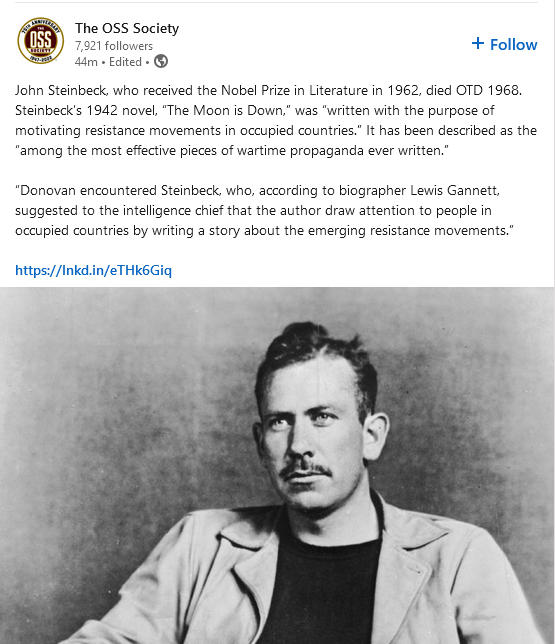
Here’s the thing…literary fiction was always dull to me. In fact, anyone who has had to suffer through school reading lists frequently considers the titles uninteresting. I would hardly consider any of universal interest. I wondered even why they ever bothered calling it literature. I once decided to peruse the litany of covers, cover copies, and titles. Even in the ‘00s going into the ‘10s, the entire section was about as interesting as watching paint dry. I would rather listen to the dulcet tones of nails scraping on a chalkboard than read To Kill a Mockingbird, and I think that washing my eyes in a high-molarity solution of hydrochloric acid would be preferable to reading anything by John Steinbeck—who was, by the way, an asset of the OSS, the precursor to the CIA.
And, that’s the rub. I’ve never been interested in literary novels. I’ve always found the genre dull, uninteresting, unrelatable, and lacking in any depth of meaning—or real, measurable impact. Even when completing school reading lists, I eschewed such fiction in favor of The Scarlet Pimpernel or The Hobbit. Again, I have no clue if any of these examples would be considered literary novels. For that matter, what about Mary Shelly’s Frankenstein? Is that one? Or is it just classical sci-fi horror? What exactly makes one of these literary novels after all? Commentary? A moral lesson? Frankly, Robert A. Heinlein did a better job at providing an internally consistent structure of moral philosophy underpinning a system of government in Starship Troopers than I’ve seen in books dedicated to ethics and government. Meanwhile, Starship Troopers was also actually fun and interesting to read. And, yet, Starship Troopers will never be considered a literary novel by the self-appointed literary elite at the New York Times.
What about writing, though? Surely, we can agree on that kind of “literary man” and welcome him into the fold. Right? Right?
It’s possible, but I doubt it. A lot of publishing houses have grown too comfortable with the status quo. If anyone thinks that they’re going to rock the boat by, for example, publishing a literary novel with strong conservative, Christian, or even libertarian leanings, then I’ve got a bridge for sale…it’s only lightly used, and the buyer is responsible for transportation. It’s just too much safer for them to continue publishing exactly what they’ve been publishing as literary fiction for over a century.
No, I’m afraid that even that kind of “literary man” (that is, the conservative or libertarian) will remain an outcast for the near future, largely relegated to independent and self-published outlets. And, again, very little, if any, of this will show up on the radar of publishers or outlets like the New York Times. Of course, there is also this message to give to the NYT:
The New York Times has spent the last decade or so publishing opinion article after opinion article denigrating men. Only now do they supposedly care when publishers’ pocketbooks might be hurting and it’s becoming obvious to even the most brain-dead that their awards have become the annual presentation of the self-licking ice cream cone. Well guess what, we men, especially straight, white, Christian men got the message loud and clear: you hate us, you don’t respect us, and you don’t want us in society. You don’t get to bully people that way and expect what you’ve done to magically go away and get better. I’ve got bad news for the literary elite: the feeling has become mutual. We don’t respect you. We don’t want you. And, for many of us, it is a struggle not to hate your guts.
So to the literary elite and the staff at the New York Times: go take a flying leap off of a tall cliff. Go shove your literary awards where the sun don’t shine. Take your critiques and “thoughts” (if they can be called that) and go yell them at the wall. (The wall is more likely to listen at this point.) The literary man hasn’t disappeared. We just decided to take our ball and go home because we think that you’re not worth trying to play nice with anymore.

Feel free to ask questions or make comments below…